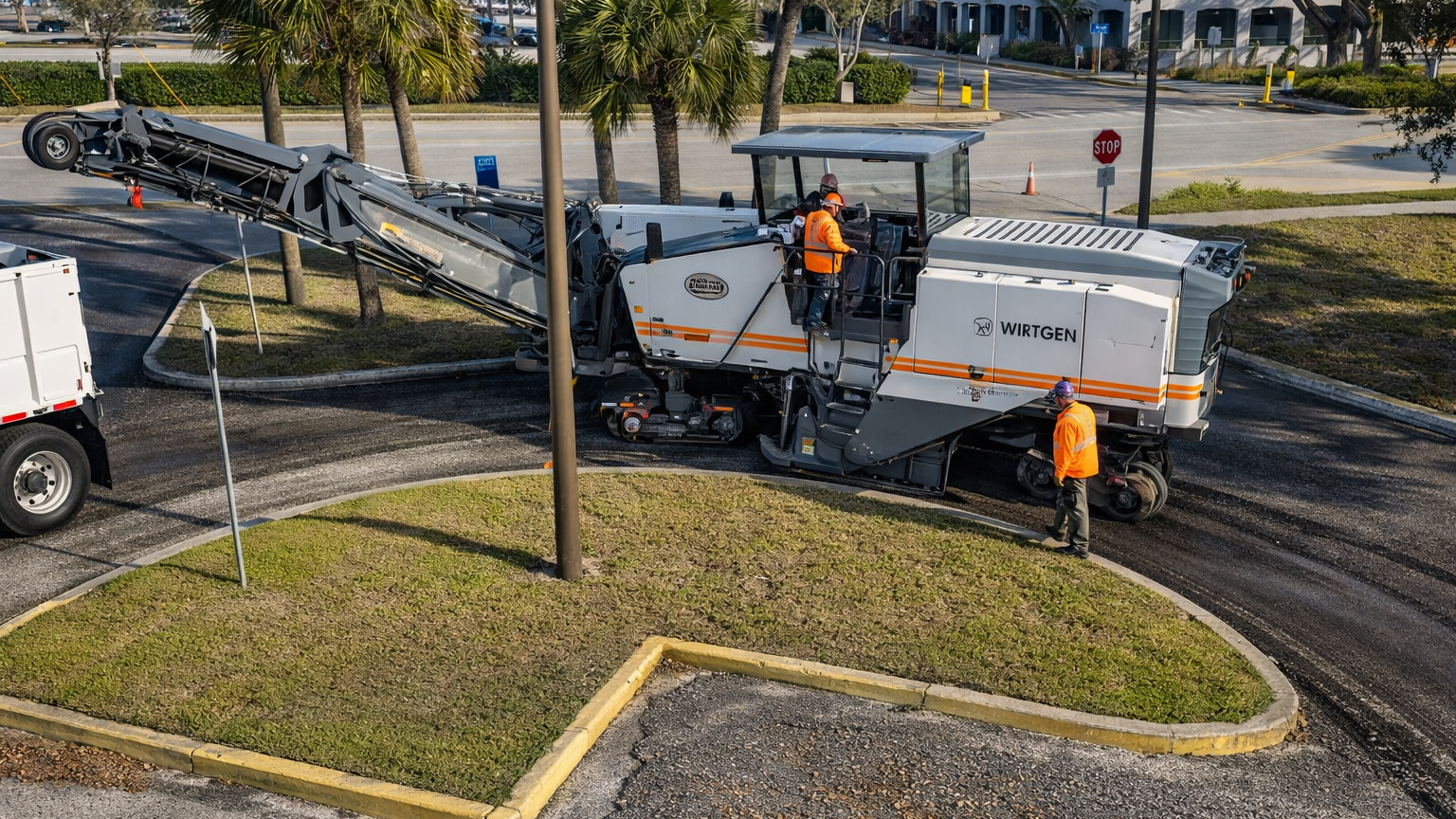
Road Milling for Highways, Streets, and Industrial Areas
Road milling solutions for highways, streets, and industrial areas, focused on efficiency, precision, and surface preparation.
Blacktop
Feb 6, 2026 · 6 min read
When a road looks “fine” from a distance, it can still be failing underneath. Cracks, rutting, uneven surfaces, and drainage issues don’t just appear overnight, they build up slowly until repairs become expensive and disruptive.
The good news? In many cases, you don’t need to rebuild the pavement from scratch. The smarter solution often starts with road milling, the key step that prepares highways, streets, and industrial pavement for a strong, smooth asphalt surface that lasts.
At Blacktop Florida, we specialize in asphalt paving and milling across Central Florida, helping commercial, industrial, and municipal clients restore pavement efficiently and correctly.
What Is Road Milling?
Road milling (also called asphalt milling or cold planing) is the process of removing the top layer of asphalt using specialized milling equipment. This removes damaged pavement and creates a clean, level surface for a new asphalt overlay.
Instead of tearing out the entire road structure, milling allows contractors to correct surface problems while preserving the base layer when it’s still structurally sound.
Why Road Milling Is Essential Before Repaving
Milling is not just “removing asphalt.” It’s a precision process that improves the quality of the next pavement layer.
Key benefits of asphalt milling
Restores proper road elevation and smoothness
Removes cracks, potholes, and surface failures
Improves bonding for the new asphalt overlay
Corrects water drainage issues
Extends pavement lifespan while reducing cost
Helps avoid uneven transitions at curbs, entrances, and ramps
A properly milled surface sets the foundation for a long-lasting pavement system.
Road Milling for Highways
Highways require strong, consistent pavement performance under constant heavy traffic. Milling is commonly used on highways to restore surface integrity without major reconstruction.
Milling solves highway pavement problems like:
Wheel ruts caused by heavy vehicles
Polished or slick surfaces reducing traction
Uneven pavement transitions
Surface cracking spreading across lanes
Why it matters
Highway milling allows resurfacing to happen faster and with fewer traffic disruptions compared to full removal and replacement.
For DOT-style projects and large corridors, accuracy is everything, depth control, slope correction, and smoothness directly affect safety and durability.
Road Milling for Streets and City Roads
Streets in Central Florida face constant wear from traffic, weather, and utility work. Milling is ideal for municipal roads because it restores the pavement while maintaining the correct elevation around curbs, storm drains, and intersections.
Common street milling applications
Neighborhood street resurfacing
Downtown and commercial corridor restoration
Utility cut repair preparation
Road widening or resurfacing upgrades
Why cities choose milling
It’s a cost-effective way to improve ride quality and correct damaged asphalt without rebuilding the entire roadway.
Asphalt Milling for Industrial Areas
Industrial pavement is built for pressure: tractor trailers, forklifts, loading zones, and constant weight. Over time, industrial asphalt surfaces deform, crack, and develop low spots.
Milling is often the best solution because it allows surface restoration without shutting down operations for long periods.
Industrial milling is commonly used for:
Distribution centers and warehouse yards
Truck routes and industrial roads
Heavy-duty loading docks
Manufacturing plants and paved storage areas
The advantage for industrial clients
Milling allows pavement to be repaired in phases, reducing downtime while restoring safe, level surfaces for equipment and trucks.
How the Road Milling Process Works
Professional milling is a controlled process that requires the right equipment and planning.
Typical steps include:
1. Site evaluation and pavement inspection
The first step is identifying how deep the asphalt needs to be removed and whether the base is still stable.
2. Milling the asphalt surface
A milling machine removes the damaged layer at a specific depth while maintaining the correct slope and grade.
3. Cleanup and surface preparation
The milled surface is cleaned and prepared to ensure proper bonding for the next asphalt layer.
4. Asphalt overlay or paving installation
Once the surface is milled and prepped, a new asphalt layer is installed for a smooth, durable finish.
When done correctly, the result is a pavement surface that performs like new.
When Do You Need Road Milling Instead of Simple Patching?
Not every pavement problem can be fixed with patchwork. If the damage is widespread, patching often becomes a temporary solution that costs more over time.
Signs milling may be the right solution:
Repeated cracking across large areas
Uneven road surfaces and dips
Rutting from heavy vehicle traffic
Potholes that keep returning
Water pooling after rain
Pavement surface breaking down or separating
If these issues sound familiar, milling may be the best first step toward a long-term fix.
Is Milled Asphalt Recycled?
Yes. One major advantage of asphalt milling is that the removed material can often be reused as recycled asphalt pavement (RAP).
This reduces waste and supports more sustainable paving practices, especially on large-scale roadway and industrial projects.
Why Experience Matters in Road Milling Projects
Road milling isn’t just about removing asphalt, it’s about controlling precision. If milling is done poorly, it can create uneven surfaces, incorrect slopes, and costly paving issues later.
A skilled contractor ensures:
Correct depth consistency
Proper transitions at entrances and intersections
Smooth surface profile for overlay
Efficient project timelines
Safe, clean work zones
For highways, streets, and industrial areas, milling must be done with expertise and the right equipment.
Road Milling Services in Central Florida by Blacktop Florida
At Blacktop Florida, we provide professional asphalt milling and paving services for:
Highways and roadway projects
Municipal streets and neighborhoods
Industrial yards and truck routes
Commercial properties and access roads
With over a decade of experience, we’re known for being one of Central Florida’s most reliable asphalt contractors, delivering clean work, efficient scheduling, and results built to last.
Request a Quote or Schedule a Milling Inspection
If your pavement is showing signs of wear, cracking, rutting, or uneven surfaces, milling may be the smartest solution before resurfacing.
Contact Blacktop Florida today to request a quote, schedule an inspection, or discuss your highway, street, or industrial milling needs, whether the job is urgent, planned, or part of a long-term maintenance strategy.
Stay Connected With Our Blog
Follow the Blacktop Florida Blog for weekly updates where we share paving tips, project insights, maintenance guidance, and key concepts to help you make better decisions about your asphalt. And remember, if you need asphalt milling, paving, resurfacing, or an inspection in Central Florida, don’t wait. Contact Blacktop Florida anytime for fast, professional service.